
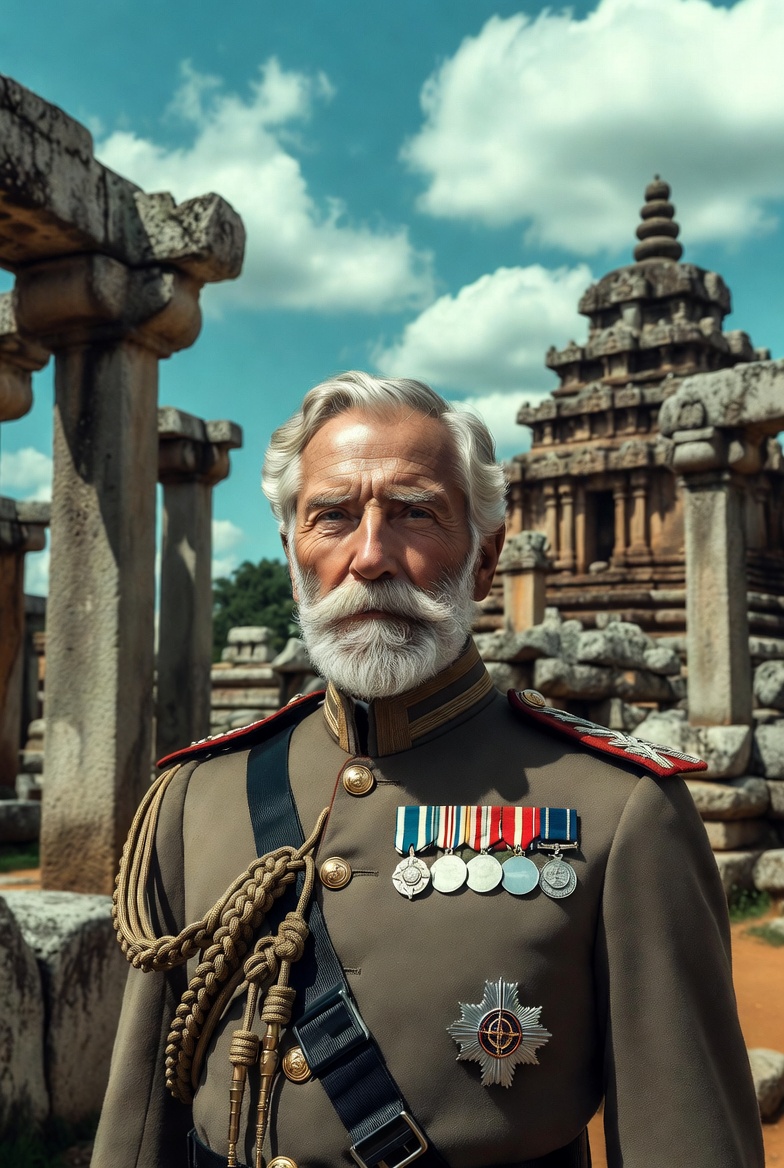
The Father of Indian Archaeology: A Historical Review of Cunningham’s Buddhist Discoveries

Sir Alexander Cunningham (1814–1893), was a British army engineer who is universally recognized as the “Father of Indian Archaeology”. As the first Director-General of the Archaeological Survey of India (ASI), founded in 1861, Cunningham’s work fundamentally shifted the study of Buddhism from a purely textual discipline into a grounded, archaeological science.

Before Cunningham, the physical geography of the Buddha’s life and the subsequent spread of the religion under the Mauryan and Gupta empires were largely lost to time. Through a combination of rigorous field surveys, structural excavation, and numismatics, Cunningham resurrected the spatial and material history of early Buddhism.

Methodological Innovation: Textual Mapping

Cunningham’s greatest methodological contribution was his reliance on the travelogues of early Chinese Buddhist pilgrims—specifically Faxian (Fa-Hien, 5th century CE) and Xuanzang (Hsuen Tsang, 7th century CE). These monks had meticulously recorded distances, directions, and descriptions of the Buddhist sites they visited in India.

Cunningham treated these texts not as mere myths, but as literal maps. By combining their accounts with classical Greek records (like the campaigns of Alexander the Great) and geographic surveys, he successfully retraced the steps of the pilgrims to identify long-lost sites, including Nalanda, Taxila, and Kushinagar.

Major Excavations and Discoveries

1. Sarnath: The First Sermon

At age 21, while stationed in Benares (Varanasi), Cunningham began exploring nearby Sarnath, the site where the Buddha delivered his first sermon. In 1837, and later in the 1850s, he excavated the Dhamek Stupa, a massive 5th-century CE structure. Furthermore, he worked alongside the scholar James Prinsep to translate inscriptions found at the site, which helped confirm the location’s immense theological significance. He also uncovered the famous Ashoka Pillar with its lion capital, which remains a masterwork of Mauryan art.

2. Sanchi and the Bhilsa Topes

In 1850, Cunningham excavated the stupas at Sanchi, one of the oldest surviving stone structures in India.

Alongside Lieutenant F.C. Maisey, he sank shafts into several stupas in the region. Inside Stupa No. 3, they discovered steatite relic caskets containing the bone fragments of Sariputta and Mahamoggallana—two of the Buddha’s chief disciples. This discovery provided physical validation of the early Buddhist canonical texts.

3. The Bharhut Stupa: Rescuing Early Iconography

In 1873, Cunningham stumbled upon the ruins of the Bharhut Stupa in Madhya Pradesh. The stupa itself had been largely dismantled by local villagers who were using its bricks for construction. Cunningham realized the immense value of the remaining red sandstone railings (vedika) and gateways (torana), which featured some of the earliest known examples of Buddhist narrative art.

Recognizing that leaving the stones on-site would result in their total destruction, he transported the heavy stone fragments to the Indian Museum in Kolkata. These carvings are pivotal to art historians because they depict the Buddha aniconically (through symbols like footprints, an empty throne, or the Bodhi tree) and illustrate numerous Jataka tales (past lives of the Buddha).

4. Mahabodhi Temple and Kushinagar

Cunningham was directly responsible for the restoration of the Mahabodhi Vihara at Bodh Gaya, the site of the Buddha’s enlightenment. During his work there in 1881, he discovered the Vajrasana (the Diamond Throne) and several Ashokan pillared bases.

He also identified Kushinagar (Kusinara) as the site of the Buddha’s Mahaparinirvana (final passing), unearthing a 1,500-year-old reclining Buddha statue that matched the exact descriptions left by Xuanzang.

Chronology of Discoveries

Sarnath Explorations

1837

Began investigations at Sarnath, leading to the excavation of the Dhamek Stupa and the Ashoka Pillar.

Sanchi Excavations

1850

Excavated the Great Stupa at Sanchi and surrounding sites, discovering the relics of key Buddhist disciples.

Establishment of the ASI

1861

Appointed as the first Archaeological Surveyor to the Government of India, formally establishing the Archaeological Survey of India.

Discovery of Bharhut

1873

Identified the heavily damaged Bharhut Stupa and rescued its invaluable narrative reliefs for preservation in Kolkata.

Mahabodhi Restoration

1881

Led the restoration of the Mahabodhi Temple at Bodh Gaya, uncovering the Vajrasana and Ashokan relics.

Primary References and Publications

For scholarly research, Cunningham’s own comprehensive monographs and ASI reports remain primary texts in the field of Buddhist archaeology. His major publications include:

  • The Bhilsa Topes, or Buddhist Monuments of Central India (1854): The first serious attempt to trace Buddhist history systematically through architectural remains, detailing his findings at Sanchi.
  • The Ancient Geography of India (1871): A monumental work synthesizing the campaigns of Alexander the Great and the travelogues of Xuanzang to reconstruct the historical landscape of the Buddhist period.
  • The Stûpa of Bharhut: A Buddhist Monument Ornamented with Numerous Sculptures (1879): The definitive record of the aniconic art, Jataka reliefs, and inscriptions he rescued from the site.
  • Mahâbodhi, or the Great Buddhist Temple under the Bodhi Tree at Buddha-Gaya (1892): His final major work detailing the excavations and the structural history of the site of enlightenment.
General Blog

The Historical Evidence for Gautama Buddha’s Birthplace in Ancient India (Lumbini Region): A Comprehensive Scholarly Overview

The scholarly consensus across Indology, Buddhist studies, archaeology, epigraphy, and historiography is overwhelming: Siddhattha Gotama (the Buddha) was born in Lumbini (in the ancient Shakya republic, modern Nepal, culturally and historically part of the Gangetic cultural sphere of ancient India), lived primarily in the Middle Gangetic plain (Magadha and surrounding regions), attained enlightenment at Bodh Gaya, delivered his first sermon at Sarnath (near Varanasi), and passed away at Kushinagar—all in present-day India/Nepal border areas.

This is supported by multiple independent lines of evidence spanning centuries. Fringe theories claiming the Buddha was born in Sri Lanka (often alleging British colonial “conspiracy” to relocate Sri Lankan place names or sites to India, misreadings of proper names, or attacks on historians like Romila Thapar) lack credible support and contradict primary sources. These ideas appear in some modern nationalist or revisionist circles but are dismissed by mainstream scholarship as pseudohistory.

1. Primary Textual Evidence from the Earliest Buddhist Sources

The Pali Canon (Tipiṭaka), the earliest surviving Buddhist texts (compiled orally and written down centuries after the Buddha but preserving pre-sectarian material), consistently locates all major events of the Buddha’s life in ancient India:

  • Birth in Lumbini (near Kapilavatthu, Shakya territory).
  • Renunciation, asceticism, and enlightenment in the Gangetic region.
  • Teaching career centered in Magadha, Kosala, etc.
  • Parinibbāna (final passing) at Kushinagar.

No early text places his birth in Sri Lanka (Lanka). Later Mahāyāna texts follow the same geography.

Chinese pilgrims Faxian (5th century CE) and Xuanzang (7th century CE) traveled extensively in India and Nepal, describing these exact sites with distances and landmarks that match archaeological findings. Their accounts align with the Pali tradition and predate any modern “conspiracy” claims.

2. Epigraphic and Archaeological Evidence:

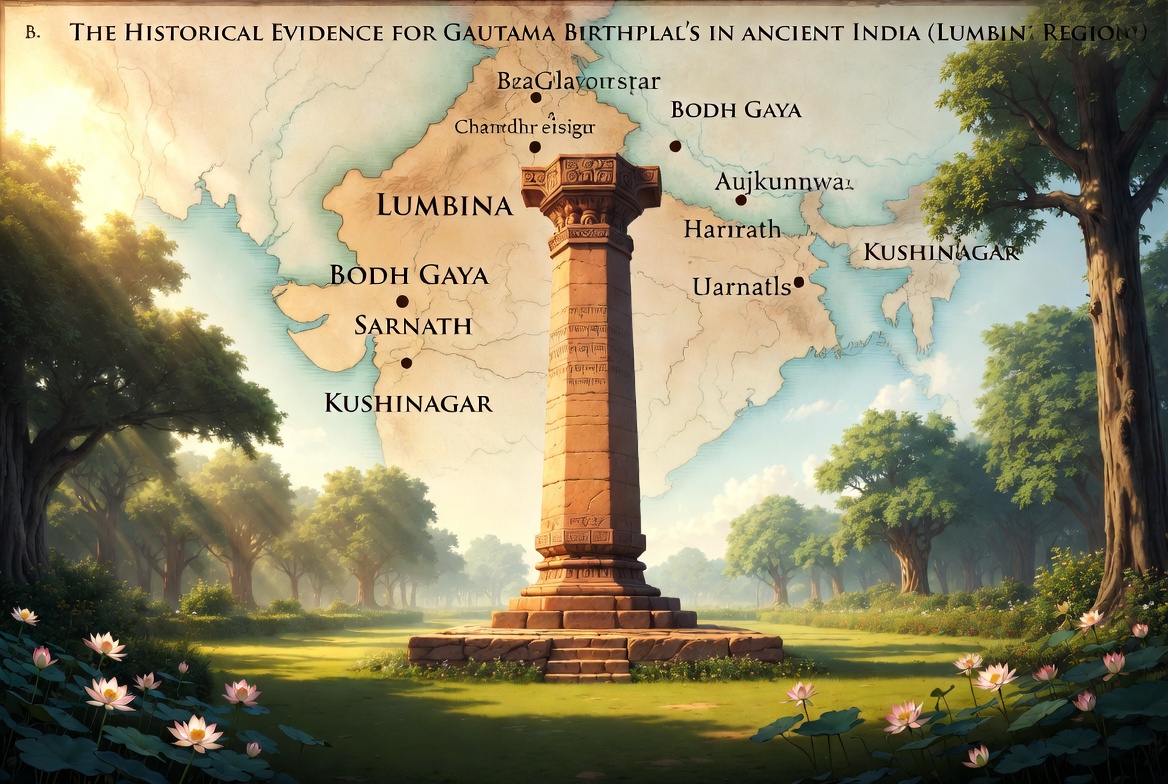
The Ashoka Pillar at LumbiniThe decisive evidence is the Lumbini pillar inscription of Emperor Ashoka (r. c. 268–232 BCE), erected in his 20th regnal year (c. 249 BCE). Discovered in 1896, it states in Brahmi script:

King Piyadasi [Ashoka], beloved of the gods, in the twentieth year of his reign, himself made a royal visit. Buddha Sakyamuni having been born here, a stone railing was built and a stone pillar erected… Lumbini village was taxed [reduced].”

This is one of the earliest direct references to the Buddha by name and explicitly identifies Lumbini as his birthplace.

Authenticity: Leading epigraphist Harry Falk has stated it is “beyond dispute.” The script shows authentic early Ashokan features (some extinct by the mid-2nd century BCE) that a forger like Alois Anton Führer (see below) could not have replicated. Recent UNESCO-sponsored excavations at Lumbini have uncovered pre-Ashokan timber structures and a sequence of shrines dating back toward the Buddha’s era, corroborating continuous veneration.

3. Sri Lankan Chronicles (Dipavamsa and Mahavamsa):

Value and LimitationsThe Dipavamsa (c. 3rd–4th century CE) and Mahavamsa (c. 5th–6th century CE, with later continuations) are invaluable for Sri Lankan history, especially from the time of Ashoka onward. Scholars like Wilhelm Geiger (translator of the Mahavamsa) and others accept a historical kernel for kings, events, and the arrival of Buddhism via Mahinda (Ashoka’s son/missionary) around the 3rd century BCE.

They describe the Buddha making three legendary visits to Lanka (to subdue yakkhas, establish sacred sites, etc.). These are mythological/legendary in character—supernatural elements like the Buddha flying or subduing demons are typical of later hagiography and not corroborated by Indian sources or archaeology. Most scholars treat them as pious legends created to sanctify the island and legitimize its Buddhist identity, not literal history. Crucially, these chronicles do not claim the Buddha was born in Sri Lanka. They consistently place his birth and life in Jambudvīpa (the Indian subcontinent/mainland), from which Buddhism was brought to Lanka. They reinforce, rather than contradict, the Indian origins.

4. Addressing Fringe Theories and Specific Claims

  • British conspiracy to move Sri Lankan place names/sites to India”: No credible evidence supports this. 19th-century British scholars (Cunningham, Turnour, etc.) used both Indian archaeological finds and Sri Lankan chronicles (translated by Turnour) to map sites. The geography was reconstructed from multiple independent sources (Pali texts, Chinese pilgrims, Ashokan inscriptions, local traditions). Claims of deliberate relocation appear in some modern online nationalist discourse but are contradicted by pre-colonial sources and archaeology.
  • Misreadings of site/proper names: Ancient texts use consistent toponyms (Lumbini/Lummini, Kapilavatthu, etc.). Fringe reinterpretations (e.g., claiming “Jambudvīpa” refers only to Sri Lanka or that Indian sites are copies) ignore linguistic, epigraphic, and geographical evidence.
  • Attacks on historians like Romila Thapar: Thapar’s work on early India and Ashoka is mainstream and evidence-based. Criticisms often stem from ideological disagreements rather than refutation of facts about Buddhist geography.
  • Anton Führer’s frauds: Führer (German archaeologist working for the British Archaeological Survey of India) was involved in the 1896 discovery of the Lumbini pillar alongside Nepalese General Khadga Shamsher. He later committed forgeries (faking inscriptions and exaggerating finds at other sites like Sagarwa) and was disgraced/forced to resign around 1898. However, experts (including Vincent A. Smith and Harry Falk) have affirmed the Lumbini inscription itself is genuine—its script and style predate Führer’s capabilities as a forger. The site’s identification rests on far more than Führer alone.

Similar older claims (e.g., Edward Upham’s 1829 suggestion of Ceylonese origins) were quickly debunked by scholars using better sources.

5. Conclusion

The convergence of the earliest Buddhist texts, Ashokan epigraphy, Chinese pilgrim records, and archaeology provides robust, multi-stranded evidence that the Buddha was born and active in ancient India (Lumbini/Gangetic region). Sri Lankan chronicles, while valuable for island history and accepting legendary visits, affirm rather than challenge this geography.Fringe theories relying on selective name reinterpretation, conspiracy narratives, or discredited individuals like Führer do not withstand scrutiny. The historical Buddha belongs to the shared heritage of South Asia, with Lumbini (Nepal) and key Indian sites as the verified locations.

Key References (selected scholarly or well-documented sources):

  • Harry Falk on Ashokan inscriptions and Lumbini authenticity.
  • Charles Allen, The Buddha and Dr Führer: An Archaeological Scandal (2008) — detailed on Führer and the discovery.
  • Wilhelm Geiger’s editions/translations and analysis of the Mahavamsa.
  • Romila Thapar’s works on early India and Ashoka.
  • Excavation reports: UNESCO/Lumbini archaeological projects (e.g., Antiquity journal articles on pre-Ashokan shrines).
  • Bimala Churn Law, Geography of Early Buddhism.
  • Standard syntheses: Richard Gombrich, How Buddhism Began; A.K. Warder on early Buddhist history.

General Blog