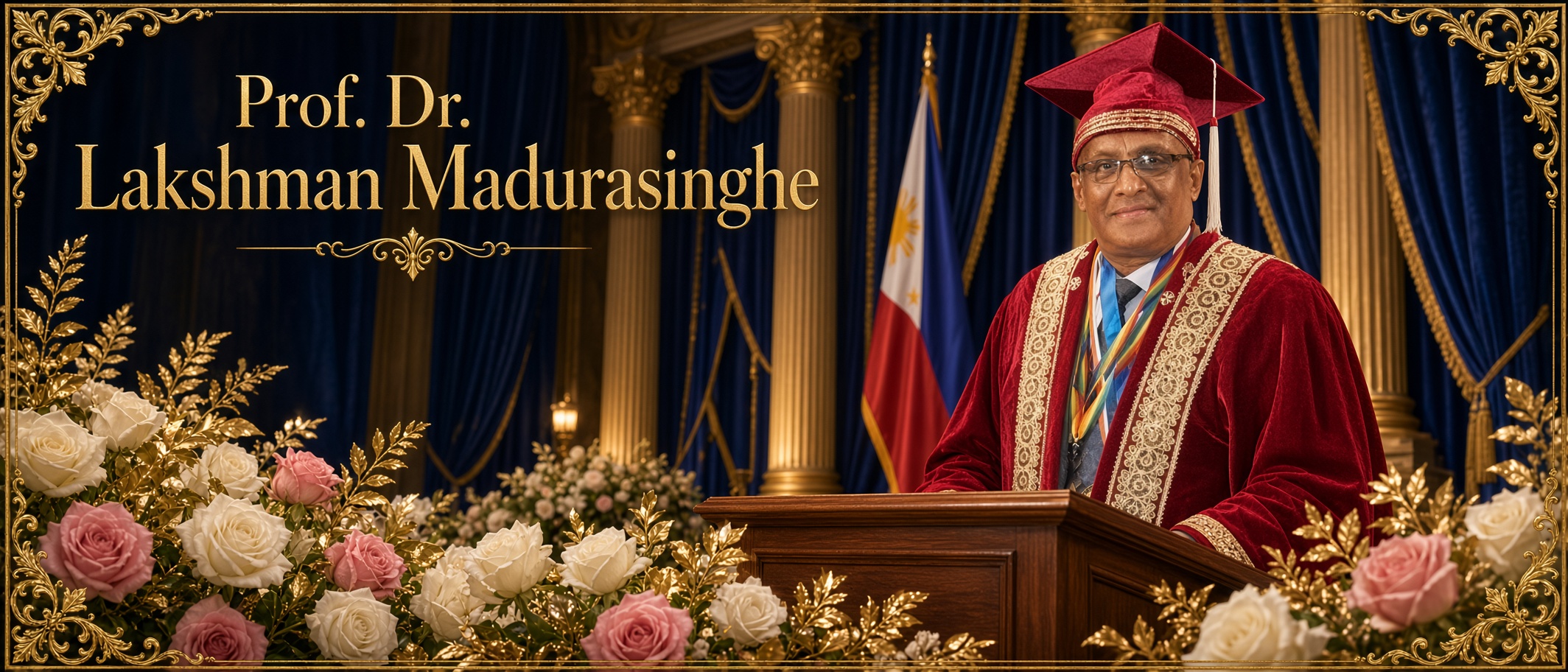
Prof. Dr. Lakshman Madurasinghe
Attorney-at-Law | Academic | Researcher | Behavioural Scientist
Prof. Dr. Lakshman Madurasinghe has developed a multidisciplinary professional career spanning law, psychology, higher education, organisational development, management, theology, comparative religion, therapeutic jurisprudence and interdisciplinary research.
His career combines legal practice and jurisprudence with university teaching, postgraduate education, psychological and behavioural sciences, corporate management, professional consultancy and international academic and institutional responsibilities.
Prof. Lakshman Madurasinghe is a visionary scholar, lawyer, behavioural scientist, and global strategist whose revolutionary philosophy of e-Consciousness inspires individuals to transcend ego-driven thinking and awaken their true potential. With a heart-centred approach to living, he advocates a transformative shift from mind to heart, fostering a life of love, learning, laughter, and enlightened living. As a pioneer in consciousness studies, he believes that expanded awareness and heart coherence will define the 5th Industrial Revolution, shaping a future of infinite possibilities. Through his work, Prof. Lakshman bridges science, spirituality, and culture, creating a lasting impact on individuals and communities worldwide.

Legal Career
Prof. Dr. Lakshman Madurasinghe was called to the Bar as an Attorney-at-Law in September 1976 following his legal studies in Sri Lanka.
His subsequent professional and academic work in law has extended into international law, constitutional law, jurisprudence, human rights, therapeutic jurisprudence and the relationship between law and psychological well-being.
His legal research has included questions relating to international law and jurisprudence, including the Act of State Doctrine, sovereign rights of states and the international law of armed conflict.
He has also lectured on areas including:
- International Law
- Constitutional Law
- Jurisprudence
- Therapeutic Jurisprudence
- Human Rights
- Law and the Legal Profession
- Artificial Intelligence and the Legal Profession
Academic Career
Prof. Dr. Madurasinghe’s academic career has developed across several disciplines, with particular emphasis on psychology, behavioural science, law, theology, comparative religion and interdisciplinary studies.
His professional profile records his appointment at Azteca University in its International Programmes as Senior Full Professor with Venia Docendi, commencing in March 2023.
His academic activities have included university teaching, postgraduate research supervision, academic administration, professional education and interdisciplinary research.
International Academic and Institutional Appointments
His professional record includes a number of international academic and institutional appointments.
Azteca University — International Programmes
Senior Full Professor with Venia Docendi
March 2023–Present
His academic work includes teaching and research in psychology and related interdisciplinary fields.
Medicina Alternativa — Alma Ata 1962
International Chairman, Medicina Alternativa and Global Consortium of Science and Technology
2015–Present
Medicina is the branch campus of Azteca University NA, which is recognised by UGC Sri Lanka.
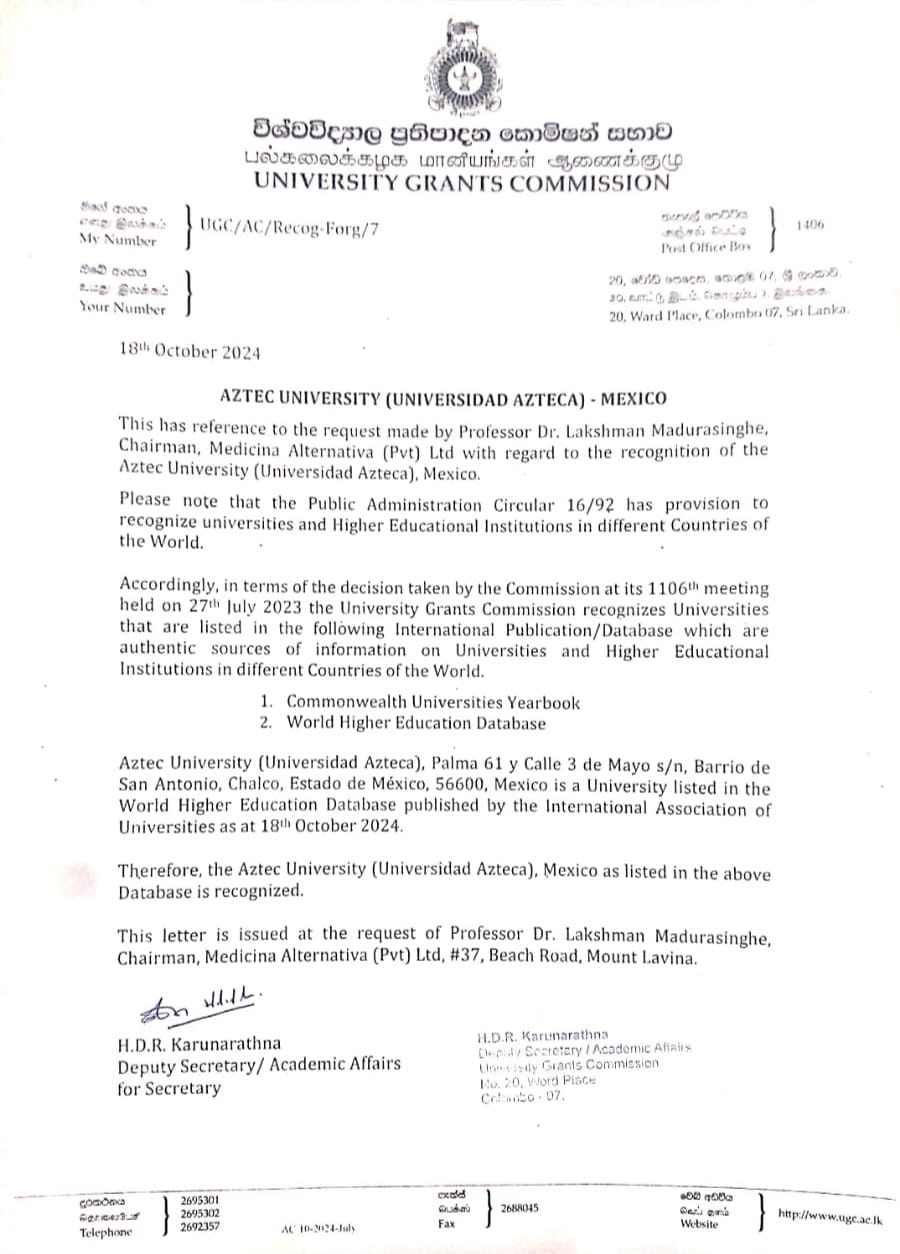
The professional record describes his continuing leadership role with Medicina Alternativa and its associated academic and institutional activities.
Academy of Universal Global Peace (AUGP), USA
Senior International Governor — Legal; Chair Judicial Council of Global Synod
2012–Present
His recorded responsibilities include legal and institutional matters and work associated with the organisation’s legal and operations functions.
Global Consultancy LLC, Albany, NY, USA
2020 – Present
Assess and mitigate potential legal risks by implementing policies and procedures, conducting risk assessments, and providing guidance on risk avoidance and mitigation strategies.
EDU — Brussels
2011–Present
The profile records his participation in the academic activities of EDU Brussels, including involvement in postgraduate academic matters.
Lifeboat Foundation
Advisory Board Member — Legal and other boards
2008–Present
His professional profile records continuing involvement with the organisation’s advisory activities.
Psychology and Behavioural Sciences
Psychology became a major component of Prof. Dr. Madurasinghe’s professional and academic career.
His professional profile identifies experience in clinical psychology, organisational behaviour, psychometric testing, occupational personality assessment, human development and behavioural science.
His work has included:
- Clinical and applied psychology
- Organisational behaviour
- Human behaviour and development
- Psychometric assessment
- Occupational personality assessment
- Stress and wellbeing
- Trauma and conflict resolution
- Psychological dimensions of law
- Therapeutic Jurisprudence
His academic and professional work has therefore developed at the intersection of psychology, law and human behaviour.
Therapeutic Jurisprudence
Therapeutic Jurisprudence represents an important interdisciplinary strand of Prof. Dr. Madurasinghe’s career.
His postdoctoral research and advanced study in this field examined the role of law as a potential therapeutic agent and considered the relationship between legal processes, emotional life and psychological wellbeing.
The work drew on literature from psychology, psychiatry, clinical behavioural sciences, criminology and social work, reflecting his interdisciplinary background in Law, Psychology and Theology.
His work in this field has subsequently informed his teaching, research and professional interests in the psychological dimensions of law.
Corporate and Organisational Career
Before and alongside his academic career, Prof. Dr. Madurasinghe developed extensive professional experience in human resources, organisational development, compensation, job evaluation, management and policy restructuring.
His professional profile records senior corporate experience with:
Standard Chartered Bank
Country Head of HR and Training
Abu Dhabi National Oil Company (ADNOC)
Senior professional responsibilities in organisational development and human resources.
Al-Futtaim, UAE
Senior professional responsibilities involving organisational development, compensation and related management functions.
The profile records this period as extending from 1982 to 1996, with responsibilities involving compensation, organisational development and policies.
His corporate work included:
- Organisational restructuring
- Job evaluation
- Compensation systems
- Market surveys
- Human-resource policy
- Labour-law and regulatory compliance
- Psychometric testing
- Statistical analysis
- Multivariate techniques
- SPSS-based analysis
- HAY and MEIRC factor-model approaches
Professional Consultancy and Training
Prof. Dr. Madurasinghe has also undertaken consultancy, management development and professional training under INTELLECT Consultancy.
His professional record identifies experience in areas including:
- Organisational development
- Compensation and reward systems
- Management development
- Emotional Intelligence
- Psychometric Testing
- Job Analysis
- Job Evaluation
- Human Resource Management
- Legal and regulatory issues
- Professional training
The professional profile records consultancy and training work involving organisations including the Asian Development Bank, International Labour Organization, SriLankan Airlines, HSBC and MAS Holdings.
Theology and Comparative Religion
A further dimension of his professional career developed through theological education, comparative religion and interfaith studies.
He has undertaken academic work in Christian theology, comparative religions, Buddhist philosophy, Islamic jurisprudence and interfaith dialogue.
His academic and teaching interests have included:
- Systematic Theology
- Comparative Religion
- Philosophy of Religion
- Christian Theology
- Buddhist Philosophy
- Islamic Jurisprudence
- Interfaith Studies
- Religious Studies
In 1990, he founded the International Institute of Theological Studies (IITS) in the Arabian Gulf, according to his professional biography. His subsequent academic work has included theological education and postgraduate teaching.
Neuroscience, Consciousness and Interdisciplinary Research
Prof. Dr. Madurasinghe’s professional career also includes longstanding interests in psychology, neuroscience, consciousness studies and human development.
His doctoral and subsequent research interests have addressed the relationship between psychological processes, brain function, consciousness and human behaviour.
This work connects with his involvement in the development of the Brain Technology and Neuroscience Research Centre (BTNRC) and with his continuing interdisciplinary research activities.
The OIUCM research record provides a more detailed account of his research programmes and publications.
Cultural Heritage and Interdisciplinary Research
His professional and research activities have also extended into Sri Lankan history, archaeology, traditional knowledge, language and cultural heritage.
One documented area of this work concerns the Beli Lena research project, in which Prof. Madurasinghe participated in research relating to ancient Sri Lankan history, archaeology and traditional healing knowledge.
These interests form part of the broader interdisciplinary character of his academic work.
Teaching, Lectures and Research Supervision
Throughout his career, Prof. Dr. Madurasinghe has undertaken university and professional teaching in areas including:
- Psychology
- Clinical Psychology
- Organisational Behaviour
- International Law
- Constitutional Law
- Jurisprudence
- Therapeutic Jurisprudence
- Comparative Religion
- Theology
- Human Rights
- Management
- Human Resource Development
His professional profile also records experience in university lecturing and postgraduate academic activity.
A separate Lectures, Seminars & Academic Supervision section provides the detailed teaching and supervision record.
Professional Development
His professional development has included specialised training in:
- HAY job evaluation
- MEIRC systems
- Multivariate Analysis
- MANOVA
- Principal Component Analysis
- Factor Analysis
- Executive Compensation
- Psychometric Testing
- Occupational Personality Assessment
The professional profile specifically records HAY-UK training in 1983 and MEIRC training in Beirut in 1986.
A Multidisciplinary Career
Prof. Dr. Madurasinghe’s career can therefore be viewed across several interconnected professional domains:
Law & Jurisprudence
Attorney-at-Law • International Law • Constitutional Law • Therapeutic Jurisprudence
Psychology & Behavioural Science
Clinical Psychology • Organisational Behaviour • Psychometrics • Human Development
Higher Education
University Teaching • Postgraduate Education • Academic Administration • Research Supervision
Management & Organisational Development
Human Resources • Compensation • Job Evaluation • Organisational Restructuring
Theology & Comparative Religion
Theology • Comparative Religion • Religious Studies • Interfaith Dialogue
Neuroscience & Consciousness Studies
Psychology • Neuroscience • Consciousness • Human Development
Cultural Heritage & Interdisciplinary Research
Sri Lankan History • Archaeology • Traditional Knowledge • Cultural Studies
Related Academic Records
For the complete academic record, see:
Academic & Professional Profile
Education • Affiliations • Career • Honours • Professional Development
Research & Publications 1980–2026
Research areas • Publications • Books • Theses • Conference papers • Current research
Lectures, Seminars & Academic Supervision
Teaching • Lectures • Seminars • Postgraduate supervision
Honours and Awards
Awards • Honours • Scholarships • Specialised training
Orcid
External scholarly and citation record
LinkedIn
External professional profile
You must be logged in to post a comment.