

The Führer Forgeries: Archaeological Fraud and its Shadow over Buddhist Relic Authenticity
Dr. Alois Anton Führer (1853–1930) was a German Indologist and clergyman who served as the Archaeological Surveyor for the North-Western Provinces and Oudh in British India during the late 19th century. Initially regarded as a promising scholar who successfully reorganized the Lucknow Museum, Führer is now infamous for executing one of the most damaging series of forgeries, plagiarisms, and falsifications in the history of South Asian archaeology. His actions not only humiliated the colonial archaeological establishment but also cast a century-long shadow over the credibility of significant Buddhist discoveries (HUXLEY, 2010).
Fabrications and Epigraphical Fraud
Führer’s fraudulent activities spanned multiple regions and archaeological disciplines. He routinely plagiarized the works of other scholars, falsified excavation reports, and submitted entirely fake epigraphical data.
During an 1893–94 tour of Burma, Führer “invented in toto” inscriptions that did not exist. He artificially constructed these fake texts from obscure publications to support his own theories about the influence of North-Indian Buddhism on Burmese architecture (HUXLEY, 2010).
In the Terai region near the modern border of India and Nepal, Führer also continually made up reports regarding the ancient site of Kapilavastu (the childhood home of Siddhartha Gautama). He submitted official reports describing vast ruined stupas ready for excavation that were completely non-existent (FAlk, n.d.). Furthermore, finding himself filling a post for which he was underqualified, he engaged in distributing forged relics of the Buddha, including passing off a fake Buddha tooth to a Burmese monk (FAlk, n.d.).
The Tainting of the Piprahwa Discovery
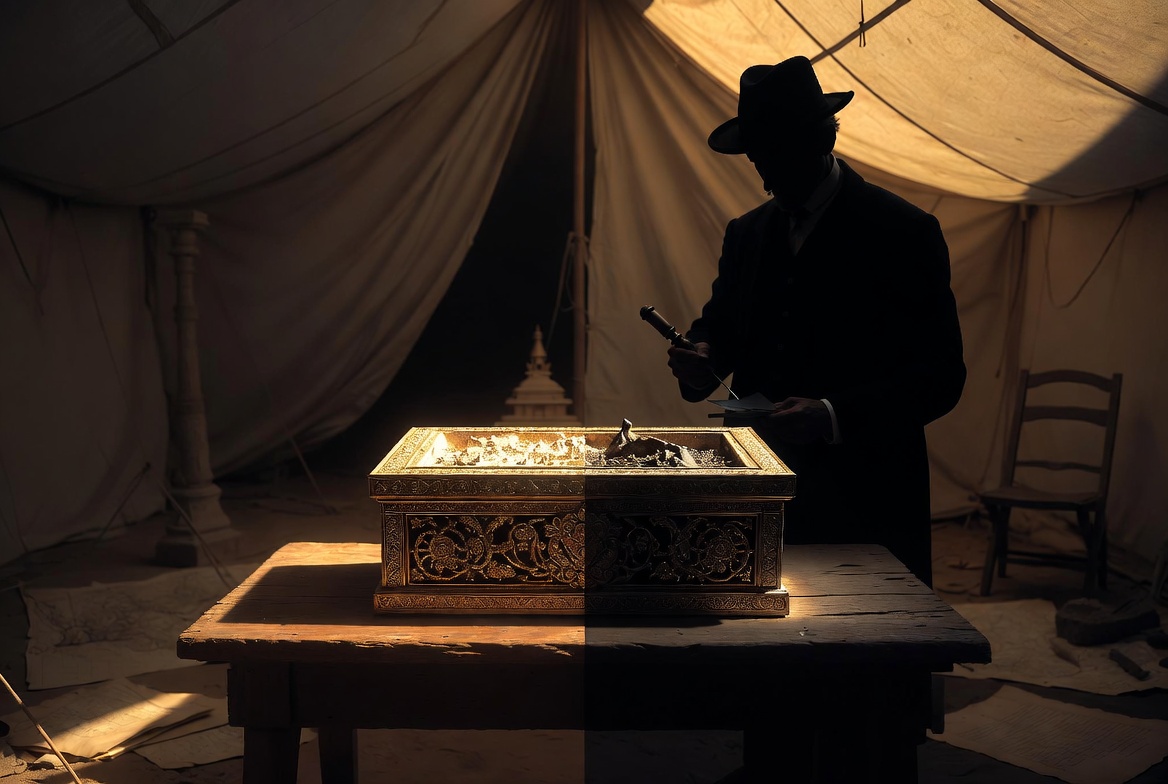
Führer’s most lasting damage to Buddhist credibility concerns his association with the Piprahwa Stupa. In January 1898, a British landowner named William Claxton Peppé excavated a brick stupa on his estate at Piprahwa. He uncovered a massive stone coffer containing several soapstone and crystal reliquary urns. One of the urns bore a Brahmi inscription claiming to contain the bone relics of the historical Buddha, enshrined by his Shakya kinsmen (Allen, n.d.).
Because Führer was acting as an archaeological surveyor in the region at the time, he quickly attached his name to Peppé’s genuine discovery. When Führer was exposed as a serial forger later that year by the antiquarian Vincent Smith and the epigraphist Heinrich Lüders, the Government of India forced his resignation, suppressed his publications, and quietly hushed up the scandal (Allen, n.d.).
However, the damage was irreversible. The proximity of a known fraudster to the Piprahwa find led generations of scholars to suspect that the Piprahwa inscription—and perhaps the relics themselves—were planted or tampered with by Führer.
Impact on Buddhist Credibility
The fallout from Führer’s exposure had severe consequences for the global Buddhist community and the study of its early history:
- Diplomatic Friction over Relic Distribution: At the time of the Piprahwa discovery, the British Government of India had agreed to offer the newly discovered relics to King Chulalongkorn of Siam for distribution among the Buddhist nations of Ceylon, Burma, and Siam. Führer’s scandal broke just as these diplomatic arrangements were being finalized. The revelation that the consulting archaeologist was a known fraudster placed a heavy question mark over the authenticity of the sacred remains, complicating their transfer and embarrassing the involved governments.
- The “Siam Conspiracy” and Century-Long Skepticism: For over a century, epigraphists and historians debated whether Führer had forged the Piprahwa Brahmi inscription to secure academic glory. This intense scholarly doubt meant that one of the most important archaeological sites in Buddhist history was treated with suspicion. It was only in recent decades that modern epigraphical analysis largely cleared the Piprahwa inscription of Führer’s taint, confirming its antiquity (FAlk, n.d.).
- The Weaponization of Doubt: Führer’s well-documented tendency to distribute fake relics provided permanent ammunition for skeptics to question the historical legitimacy of early Buddhist sites. His audacity in fabricating evidence gave critics a persistent reason to doubt the physical legacy of the historical Buddha.
Führer’s legacy serves as a stark historical case study of how a single bad actor in the archaeological record can deeply destabilize the historical and spiritual credibility of an entire religious tradition.
References
Allen, C. (n.d.). What Happened at Piprahwa.
Cited by: 2
FAlk, H. A. (n.d.). The Ashes of the Buddha.
Cited by: 21
HUXLEY, A. (2010). Dr Führer’s Wanderjahre: The Early Career of a Victorian Archaeologist. Journal of the Royal Asiatic Society, 20, 489-502. https://doi.org/10.1017/s1356186310000246
Cited by: 14
 Faculty of Law and Philosophy