
Islam
Textus receptus is not the same as textus originalis……. This means that the Quran has also been amended.
The authenticity of textus receptus
Muslims would say no to this and expect us to believe that it was never amended – but see the following Suras :
Sura 2:106
None of our revelations do we abrogate or cause to be forgotten but we substitute something better or similar. (Please also refer to Sura 16:101)
In a number of places the Quran was changed by Mohammed by taking a verse or two and replacing them with something else. This is inspite of Sura 6:34 which says there is none that can change God’s word. A famous Islamic theologian thinks that this could amount to about 500 verses.
We clearly know of the following:
The direction of prayer Sura 2:142-144
The night prayer Sura 73;2,20
Verses Missing from the Qur’an
In addition to the verses mentioned in the two traditions from the Sahih Muslim, there are evidences of others missing today from the Qur’an. Some of these are the following:
1. The Religion of Allah is al-Hanifiyyah
There is a tradition from the Jami as-Sahih of at-Tirmidhi that the following verse once formed part of Suratul-Bayyinah (Surah 98) of the Qur’an:
The religion with Allah is al-Hanifiyyah (the Upright Way) rather than that of the Jews or the Christians, and those who good will not go unrewarded. (As-Suyuti, Al Itqan fii ‘Ulum al-Qur’an, p. 525). This passage could well have once belonged to the Surah as it fits well into its context and contains words found elsewhere in it, namely din (religion, v. 5), aml, (to do, v. 7) and hunafa (upright, v. 4). The Surah also contrasts the
way of Allah with the Jews and Christians in other passages in the text and it is a good example of a verse now missing from the Qur’an.
2. Stoning of Adulterers to Death
Umar ibn al-Khattab, one of the very closest companions of Muhammad and his second successor, taught plainly from the pulpit in Medina while he was Caliph that whereas Surah 24.2 teaches that adulterers should be lashed with a hundred stripes, a verse in the Qur’an originally stipulated that married men and women who commit adultery were to be stoned to death:
See that you do not forget the verse about stoning and say: We do not find it in the Book of Allah; the Apostle of Allah (may peace be upon him) had ordered stoning and we too have done so, after him. By the Lord Who holds possession of my life, if people should not accuse me of adding to the Book of Allah, I would have had this transcribed therein: “The adult men and women who commit adultery, stone them”. We have read this verse.
(Muwatta Imam Malik, p. 352) Various other sources confirm that this verse was originally part of the Qur’an but is now missing from it. One quotes
Umar as saying that part of the scripture revealed to Muhammad was the ayatur-rajam (the Stoning Verse) and that they memorised, understood and recited it. He added that he feared people in time to come, on finding no mention of the verse in the Qur’an, would forget the ordinance (Sahih al-Bukhari, Vol. 8, p. 539).
3. Being the Offspring of Fathers Alone
Another verse said by Umar to have been originally part of the kitabullah (the “Book of Allah”, that is, the Qur’an) but which, by his time as caliph, had been lost from its text read as follows:
O people! Do not claim to be the offspring of other than your fathers, as it is disbelief on your part that you claim to be the offspring of other than your real father. (Sahih al-Bukhari, Vol. 8, p. 540)
4. The Good Pleasure of Allah
Anas ibn Malik, another companion of Muhammad, taught that the following verse originally formed part of the Qur’an but was later abrogated and deleted from its text:
Convey to our people on our behalf the information that we have met our Lord, and He is pleased with us, and has made us pleased. (Sahih al-Bukhari, Vol. 5, p. 288)
It is also recorded that this text was “sent down in a Qur’an verse until it was withdrawn” (As-Suyuti, Al Itqan fii ‘Ulum al-Qur’an, p. 527). It is yet another proof that the Qur’an has not been preserved free from any change, alteration or omission as Muslims believe. Instead the evidences for missing passages from the Qur’an are, as we can see, far greater than those for the Bible.
5. Marriage Between People Fed by the same Mother
Yet another tradition reported from Ayishah, one of Muhammad’s wives, states that there was once a passage in the Qur’an which taught that, if two people had been fed at the breast of the same mother at least ten times, they could not marry. Later, she said, it was reduced to five:
A’isha (Allah be pleased with her) reported that it had been revealed in the Holy Qur’an that ten clear sucklings made the marriage unlawful, then it was abrogated by five sucklings and Allah’s Apostle (saw) died and it was before that time in the Holy Qur’an. (Sahih Muslim, Vol. 2, p. 740)
These are only a selection of evidences that the Qur’an is an incomplete book. Christians should use these proofs with Muslims to show that their challenges about the textual integrity of the Bible can very easily – and far more effectively – be turned on the Qur’an. As the saying goes, people in glass houses should not throw stones
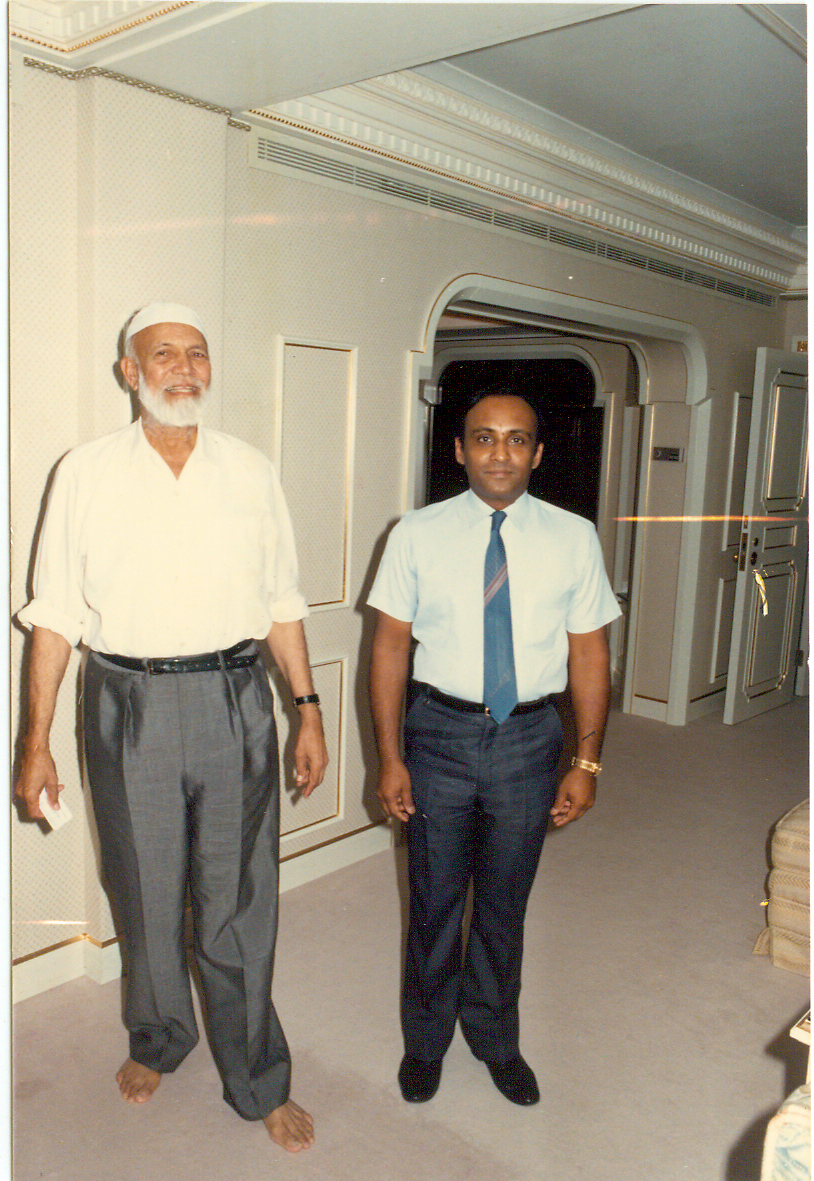
Prof.Lakshman had conducted extensive studies on Islamic Jurisprudence and lectured to global audiences on comparative religions. He had the opportunity of meeting Mr. Ahmed Deedat at Abu Dhabi Intercontinental 1987 to clarify with him the questionable views he had spread regarding Christianity.

Philosophy
- Greek Mythology
- The curse of Eleusis
- The Delphic Oracle
- Greek Gods and Goddesses
- Plato and his dialogues
- Philosophy of Religion
- Philosophy Western & Eastern
- Philosophy- Stanford University
- Understanding God
- Dark & Anti Matter
- Into the Universe
- CERN particle accelerator
- Understanding the Cosmos

One comment